Thursday, March 31, 2011

The Vanishing Vaquita

irregulartimes.com
This is the vaquita porpoise, Phocoena sinus, and it is the rarest cetacean in the world. It is also the smallest.

Barely reaching five feet in length and weighing only about a hundred pounds, this tiny porpoise lives only in the shallow waters of the northern reaches of the Gulf of California.

Fewer than two hundred remain in the wild, and these numbers are dropping significantly every year. The main reason?

scientificamerican.com
Fishing nets, particularly the hard to see gillnets, entangle and drown these wonderful creatures on a regular basis.

Mexico has established a small reserve where the vaquita can live without the fear of nets, but it may be too little, too late.

I may be a  bit of an optimist, but I believe there is still hope. As long there are people willing to make sacrifices and put forth courageous effort, I feel very few of our fellow species are beyond saving.

If you feel moved to contribute to the continued existence of this marvelous animal, which of course I hope you do, go to http://www.vivavaquita.org/. For a species perched on the brink of extinction, every little bit helps.

Wednesday, March 30, 2011

The Plant That Comes Back From The Dead

en.wikipedia.org
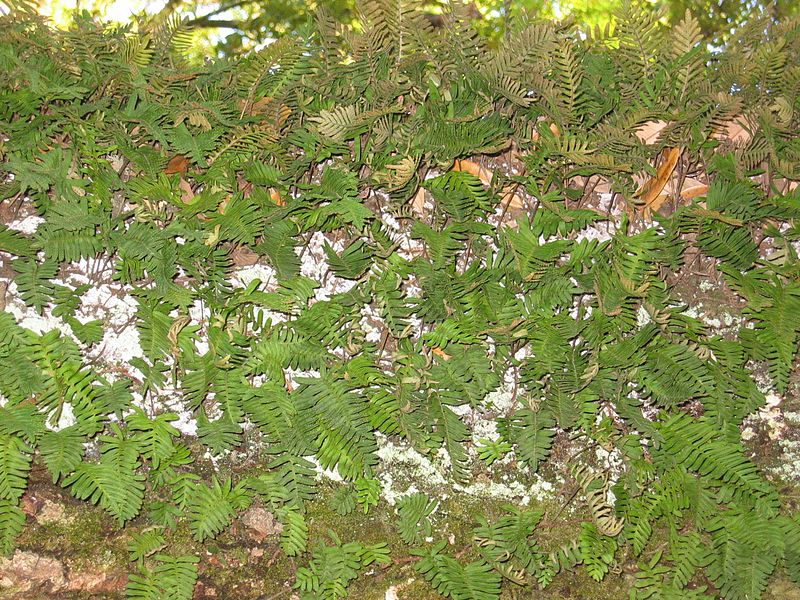
I want to show you something. Take a look at this tree limb. Imagine you are standing in the southeastern United States during an intensely dry summer.

No rain has fallen for months, and you believe the tiny dried leaves of whatever plant is sprawled across the surface of this limb must be dead. Surely, no life stirs here.

You are wrong, however, and brewing rain clouds are about to show you how wrong you are.


en.wikipedia.org
Water falls from the sky and within a few hours those dead leaves have sprung back to vibrant life.

This is Pleopeltis polyplodioides, the resurrection fern. An epiphyte that draws it's nutrients from the air and the bark it rests on, this plant can dry up in times of drought to the point where it appears dead.

Add a little rainwater, and it can swell back to life in less than twenty-four hours no matter how long its been dry.

It is estimated this plant can go without water for as long as a hundred years. It might not be able to actually bring itself back from the dead, but this remarkable little fern is still a miracle worker to me.

Tuesday, March 29, 2011

Scorpion Mothers

bugs.com
So you're walking through the tropical forest, somewhere in central Africa, and you stumble upon the creature to the right.

What is your immediate response? Fear, loathing, disgust?

What if I told you that this is a gentle, loving, and caring creature deserving of your admiration? You would scoff, no doubt, pointing out the obvious fact that nothing so ugly could be anything but a mindless monster intent on killing anything in it's path.

That's pure garbage. Beauty and wonder are so much more than skin deep and I think it is a true shame these marvelous beings aren't better appreciated.

aquaterarria.com
  Pandinus imperator, or the emperor scorpion, is a wonderful mother. Born live, her young are fully formed but very vulnerable. Immediately after birth they clamber onto their mother's back for safety. They will remain there until their first molt gives them a firmer exoskeleton.

The mother, apparently more than just a mindless protector, will even kill insects and crush them into more manageable pieces for her fragile young to feast on.

After leaving her back the young don't just vanish into the wilderness. The mother-young relationship can last from several months to several years, with the young ones remaining in the family group as adults.

I think this is just amazing. We live in a world where only birds and mammals are are allowed to be genuinely caring, but all around us are a plethora of beings in all forms putting forth great effort to see their offspring live to adulthood. What is the difference between us, in the end?

I would say it is small. What would you say?

Monday, March 28, 2011

The Golden Toad is Forever Gone

en.wikipedia.org
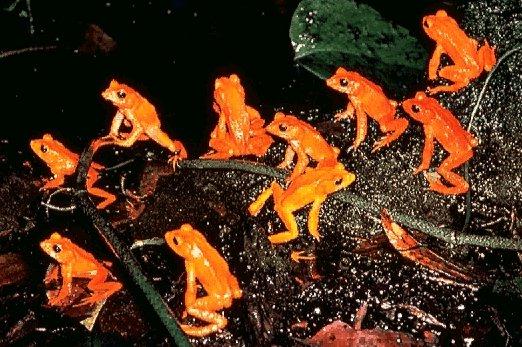
Toads are supposed to be drab. Every toad that had ever been seen since man started cataloging his fellow creatures had been so. Until 1966, when scientists exploring a four square mile preserve in the cloud draped rain forests above Monteverde, Costa Rica discovered Bufo periglenes, the golden toad. Endemic to this one small piece of forest, little is known about the lives of these enigmatic creatures.

We will never have any answers to our questions either, because this species is gone from the face of the earth forever.

esrl.noaa.gov
Staying hidden most of the year, these toads were only seen during a two week window in April. That's when the brightly colored males would gather in huge congregations around pools of rainwater to compete for a very small number of females.

1987 was a very dry year, and all the pools dried up before golden toad tadpoles could mature. Of the more than 44,000 eggs found, only twenty-nine tadpoles survived to maturity.

No golden toads have been seen since 1989.

frog-garden.com
There are many theories circulating as to the cause of the golden toad's demise. Climate change, fungal attacks, pollution, and even excess ultraviolet radiation have been blamed. Maybe it was just a natural occurrence, or maybe it was mankind's doing.

These theories are not my concern. I simply feel the need pause a moment and reflect on the passing of one of our fellow species. Nothing lasts forever, but it is a real sadness to discover such a wonder only to have it vanish such a short time later.

Farewell golden toad. You will be missed.


Sunday, March 27, 2011

The Bird That Circles the Earth

birdforums.net
Imagine living a life of almost constant summer. Imagine days that seem to never end, long glorious light filled days for the rest of your life. For the bird to the left this is no pipe dream, but stone solid reality.

Sterna paradisaea, or the arctic tern, experiences more daylight than any other creature on the planet. It also lives through two summers every year.

Its not easy being an arctic tern, however, because the way this bird gets those sweet benefits is to take part in the longest annual migration of any bird on the earth.


en.wikipedia.org
The arctic tern flies from the frozen arctic at the top of the world to the frozen seas around Antarctica, then returns, every year. It takes a winding course, and so travels more than 40,000 miles each year. The average bird will travel nearly 3 million miles over the course of it's life. That's the equivalent of flying to the moon and back five times.

Breeding in the north, fishing and resting in the south, this dauntless creature pays the hard price for a life blessed by the sun.

Below is a map showing this marvelous bird's migratory patterns and northern and southern ranges. As you look at it, imagine a small, two pound bird covering that vast distance every year.

This is truly a remarkable creature.

en.wikipedia.org

Saturday, March 26, 2011

The Poisonous Bird


documentingreality.com
Look up into the trees of Papau New Guinea's rain forests. Perhaps you will see a flash of orange and black and be lucky enough to see the bird on the left land on a branch nearby. It will not be overly cautious, but I suggest you don't get to close.

This bird is poisonous.

One of only a handful of poisonous bird species in the world, the hooded pitohui (Pitohui dichrous) is considered to be the most toxic. It contains a powerful neurotoxin called homobatrachotoxin in it's skin and feathers. Presumably, the purpose of this toxin is to defend against both parasites that would try to crawl onto it and visual predators like snakes and birds of prey that would learn to associate the bird's bright colors with a bad meal.

Not necessarily lethal to large predators, the toxin causes numbness, tingling, and discomfort when handled by humans.


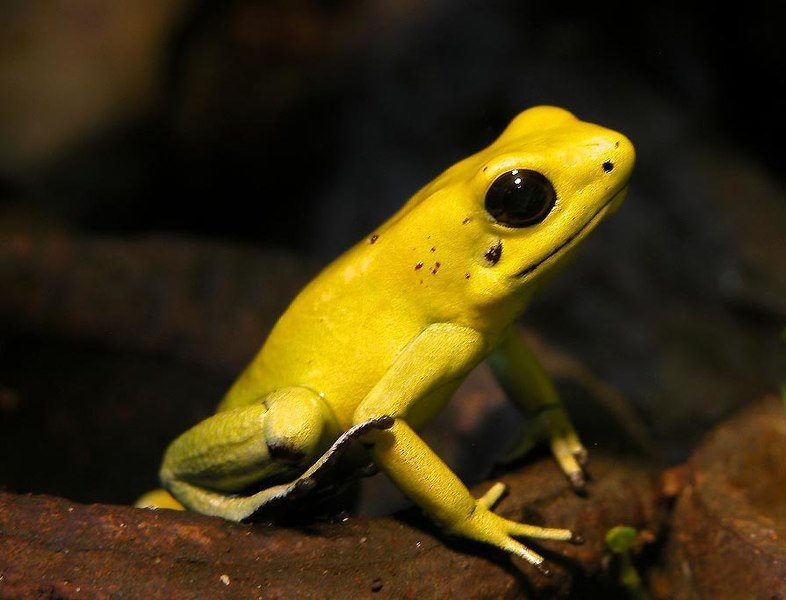
What I find most interesting about these creatures is the source of their poison. They don't actually produce it themselves, but rather acquire it by eating a specific type of beetle. The type of batrachotoxin they obtain this way is the exact same as the toxin secreted by Phyllobates terribilis, the deadly poison dart frog of Colombia which also obtains it's toxin by eating certain insects.

en.wikipedia.org


Colombia and Papau New Guinea are literally on opposite ends of the earth. Yet you have a frog in one place and a bird in the other, each acquiring the exact same toxin from the same external source. That such things are possible makes me glad to live on this planet. The wonders of this world are so many, a person could spend an entire lifetime exploring them and never run out.

Friday, March 25, 2011

Broadclub Cuttlefish Hypnotizes Prey

commons.wikimedia.org
This is one of the many faces of the broadclub cuttlefish. I say one of many because like all cuttlefish, a particularly wondrous type of cephalopod, these creatures can alter both the texture and the color of their marvelous skin in the blink of an eye.

The picture at left shows a broadclub in standard blend mode. This is how he would normally hunt his prey, sliding along the sea floor or coasting across the coral reef and taking his usually crustacean prey completely unaware. But this isn't the only trick up the broadclub's sleeve.


kpbs.org
If the prey item catches on that it is being hunted and tries to flee, or if it is large and potentially dangerous, the broadclub has a remarkable tactic I can only describe as breathtaking. It flares up, hovers over it's prey like some alien spaceship, and begins to flash it's skin like a neon sign. These rhythmic pulses of highly polarized light seem to hypnotize it's prey. Formerly active crabs freeze up and wait to be eaten.

Words really can't describe this spectacle, so I have included a video of this event below. As I always say before showing a cuttlefish video, look hard into those alien eyes. Observe them carefully whenever the cuttlefish becomes frustrated or bored. After doing so myself, I am convinced there is a powerful intelligence lurking in that spineless body.

Please comment if you do or don't agree. I'm curious to see if I'm the only one who thinks this way.